



The Soul in the New Machines (Published 2008)
The exhibition "Design and the Elastic Mind," opening at the Museum of Modern Art, explores how contemporary design is drawing inspiration from hidden patterns in nature and science, moving beyond traditional forms to embrace the transformative power of technology. This show, curated by Paola Antonelli, argues that scientific advancements have opened new avenues for visual pleasure and design innovation, echoing the revolutionary impact of MoMA’s 1934 “Machine Art” exhibition.
The exhibition highlights a departure from conventional design approaches, suggesting a new era where the ideological divides between modernity and history, technology and humanity, and individual and collective are dissolving. One of the initial exhibits features a high-tech graffiti installation where a computer-controlled spray can precisely spells out the show's title, challenging the traditional dichotomy between artistic expression and artificial intelligence. Another piece, "The Honeycomb Vase" by Tomas Gabzdil Libertiny, exemplifies "slow prototyping" where a colony of bees constructs a hive around a temporary frame, demonstrating a collaborative process between humans and nature. Similarly, Joris Laarman's "Bone Chair" utilizes software that mimics human bone creation to design a chair optimized for weight and stress, showcasing the computer's role in generating efficient and adaptable forms.
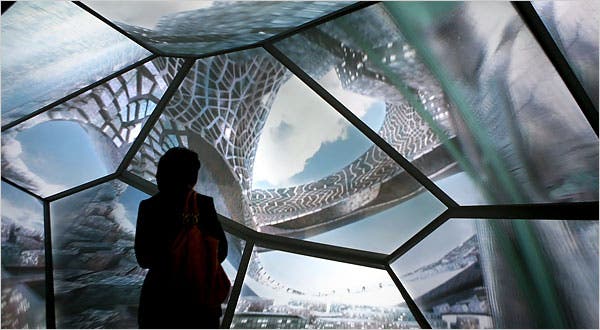
Beyond individual objects, the exhibition delves into the concept of the human body as part of a fluid, elastic chain connecting atomic particles to global networks. Benjamin Aranda and Chris Lasch’s “Rules of Six” illustrates this by using algorithms to create an organically based architecture that can scale from rooms to entire urban neighborhoods, mimicking the growth patterns of nanostructures. Oded Ezer's imaginative proposal to imprint messages on spermatozoa using nanotechnology further pushes the boundaries of design, linking advanced technology with ancient fertility rituals. The exhibition's layout, designed by Lana Hum, guides visitors through converging walls, creating a forced perspective that disorients and immerses them in the unfamiliar world of the exhibits.
The show also presents ambitious visions of future societies. “New City,” a virtual world by Peter Frankfurt, Greg Lynn, and Alex McDowell, imagines an idealized society where architecture and geography flow seamlessly, suggesting the internet as a platform for emerging utopias. In stark contrast, the "Million Dollar Blocks Project" by Columbia University’s Spatial Information Design Lab uses data visualization to expose social inequities, identifying city blocks where over a million dollars are spent annually on incarcerating residents. This graphic study demonstrates the computer's power as an analytical tool to challenge received wisdom and examine complex social problems through a new lens. While the exhibition occasionally includes less refined futuristic concepts, its broad scope effectively stimulates imagination and encourages new ways of thinking about design, technology, and their societal implications, making it a significant and uplifting presentation by MoMA's architecture and design department.
#DesignAndElasticMind #MoMADesign #TechnologicalInnovation #Bioengineering #ComputationalDesign #SustainableDesign #FutureOfArchitecture #DigitalFabrication #ArtAndTechnology #DesignAndElasticMind #MoMADesign #TechnologicalInnovation #Bioengineering #ComputationalDesign #SustainableDesign #FutureOfArchitecture #DigitalFabrication #ArtAndTechnology
 No comments yet