1/5
Why It’s Time to Think Differently About Chinoiserie
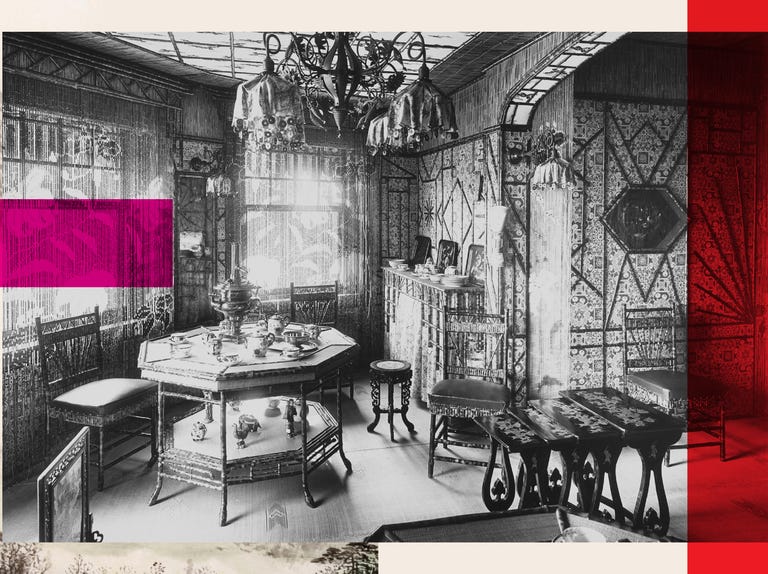
Chinoiserie, a decorative design style characterized by motifs borrowed from Asian visual culture, has been a significant element in Western interior design since the 17th century. Historically, it emerged from burgeoning trade routes between China and Western Europe, leading to a European fascination with authentic Chinese goods. This fascination gradually spurred the creation of 'inspired-by' styles, culminating in chinoiserie, which adorned everything from palaces like Louis XIV’s Trianon de Porcelaine to furniture by Thomas Chippendale. The term 'chinoiserie' itself, coined in 19th-century French culture, directly translates to 'Chinese-esque' or 'Chinese-ish,' inherently implying an approximation rather than an authentic representation.
Today, chinoiserie is experiencing a resurgence, particularly within 'grand-millennial' aesthetics on platforms like Instagram, with mass-produced items available from various retailers and high-end reproductions from firms such as Gracie and De Gournay. These contemporary manifestations often feature East Asian-inflected floral patterns and scenic landscapes, sometimes marketed under 'exotic' collections.
However, the article raises critical questions about the seemingly benign nature of chinoiserie, particularly from the perspective of Asian Americans in the design industry. Critics argue that chinoiserie is often a mere 'facsimile' of Asian culture, serving as a Western construct based on superficial perceptions rather than genuine cultural appreciation. The deployment of chinoiserie in interiors prompts questions about whose traditions are being honored, with the decorative objects becoming tacit endorsements of labor and culture, and reflecting the taste of their owners.
Scholars like Iris Moon note that while there was a genuine fascination with other cultures in the West, the imagery of chinoiserie can be destructive and troubling. She points to examples like the 1755 porcelain piece 'Chinese Musicians,' which, despite its craftsmanship, depicts slant-eyed Chinese figures in a subservient decorative arrangement, drawing parallels to blackamoor motifs. Dung Ngo, founder of August Editions, asserts that chinoiserie has little to do with actual Asian culture, comparing it to 'chop suey'—a Western invention based on limited perceptions of Asian culture.
Interior designers like Jean Liu and Young Huh acknowledge the loaded nature of chinoiserie. Liu views it as a historical artifact that requires understanding its context and a responsibility to promote culture with sensitivity. Huh emphasizes the power dynamics inherent in cultural appropriation, distinguishing between admiration and purchase between equals versus replication from a position of power. She questions the nostalgia associated with chinoiserie, asking 'who and what is it nostalgic for?'
Cultural insensitivities associated with chinoiserie range from derogatory terms like 'coolie' used for lampshade designs to appropriated caricatures in _mah-jongg_ sets. The underlying issue is often a lack of genuine interest in the history behind the aesthetic, leading to ignorance and unintended harm. Industrial designer Amanda Huynh highlights how chinoiserie reduces complex cultures to mere motifs, contrasting it with the comprehensive historical narratives associated with European design. She questions why something becomes valued only when filtered through a white European lens, arguing that chinoiserie romanticizes a time without acknowledging the struggles and joys of the cultures it borrows from.
Design curator Aric Chen suggests that while historical appropriation might have been attributed to naive ignorance, such sugarcoating of history should be reconsidered. He notes that not all designers acted with racist intent but often with an element of exoticization. The article concludes by calling for a new discourse in the design industry, advocating for a self-conscious examination of meaning and origin. Designers like Robert Sukrachand argue that chinoiserie can marginalize contemporary Chinese and Asian design. The author urges marketers, retailers, and magazine editors to steer conversations around cultural appropriation responsibly, ensuring diversity and inclusion in decision-making. The piece underscores the need for designers to inform clients about the ramifications of using problematic pieces and for a broader societal shift towards welcoming all perspectives, especially in light of increased anti-Asian prejudice. Ultimately, design should be a vehicle for connection, done with care and respect.
#Chinoiserie #DesignHistory #CulturalAppropriation #InteriorDesign #AsianAmericanPerspective #DecorativeArts #Colonialism #EurocentricDesign #DesignEthics #Chinoiserie #DesignHistory #CulturalAppropriation #InteriorDesign #AsianAmericanPerspective #DecorativeArts #Colonialism #EurocentricDesign #DesignEthics
 No comments yet
Here's What To Look For When Thrifting China Dishes