




1/12
San Francisco Is Turning Gray — One House At A Time
San Francisco, a city historically known for its vibrant and colorful homes, particularly its Victorian architecture, is experiencing a noticeable shift towards gray paint schemes, a trend documented by artist and photographer Sergio De La Torre in the Mission District. De La Torre observed this change after moving to the city and initially being impressed by the diverse palette of house colors. His documentation began with a single Victorian house, formerly a recovery house for individuals with mental illness, which was repainted gray and subsequently subdivided into expensive units, signifying a change in the neighborhood's demographics and character. This observation led him to photograph at least 175 newly gray-painted homes in the area.
The gray houses often share distinct features: dark to light gray paint, metal sans-serif house numbers, and occasionally a colorful accent like a yellow door. This aesthetic is increasingly prevalent across various San Francisco neighborhoods, including Mission District, Cow Hollow, and Pacific Heights. The article explores the historical context of house colors in San Francisco through a conversation with Tanu Sankalia, Program Director of Urban Studies at the University of San Francisco.
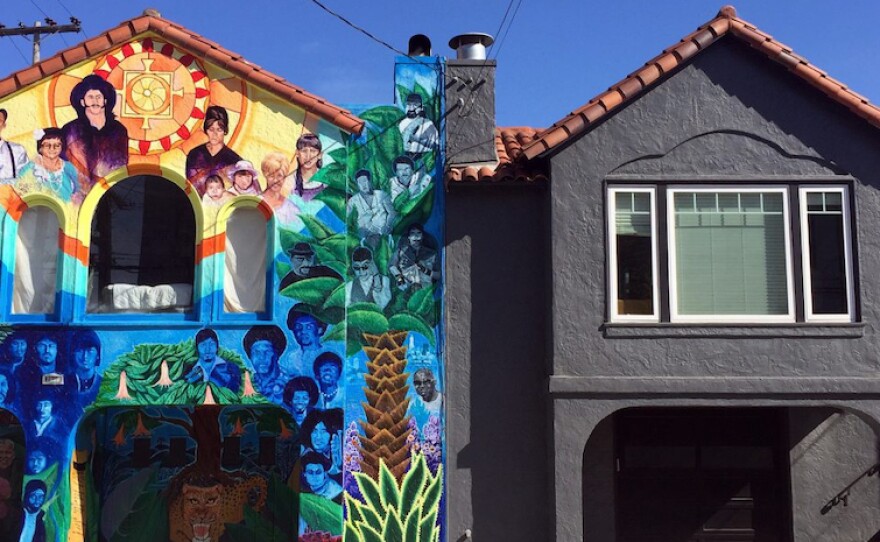
Sankalia explains that during the period of 1850 to 1905, coinciding with significant construction, houses were typically painted in subdued, earthy tones, including gray. The abundance of battleship gray paint after World War II further popularized gray, driven by a desire for austerity. However, the 1960s brought the Colorist Movement, where the hippie era's emphasis on freedom and self-expression led to Victorians being painted in bright, flamboyant colors, establishing the vibrant image San Francisco is often associated with today.
The current resurgence of gray paint is discussed in relation to gentrification, particularly in historically diverse neighborhoods like the Mission. While some associate the gray trend with the influx of wealthier, often younger residents who prefer a minimalist aesthetic reminiscent of modern technology, real estate agent and color consultant Carol Koffel offers a different perspective. She notes that the gray trend is not unique to San Francisco, citing similar movements in London, Toronto, Washington D.C., and Trondheim, Norway. Koffel suggests that gray paint allows the architectural details of a home to stand out without being visually overwhelming in a world saturated with information. She also mentions the use of lighter values of gray to create an illusion of increased height.
However, Koffel acknowledges that the widespread adoption of gray can diminish its uniqueness if too many houses on a block share the same color. The article highlights that the gray trend has permeated from architects to house flippers, with a significant percentage of flipped homes in San Francisco featuring gray exteriors. Despite the aesthetic arguments for gray, De La Torre perceives the widespread graying of houses as a stark contrast to the colorful past, symbolizing the significant social and economic changes occurring in his city, such as evictions and rising living costs. He views the 'mute' color as an ironic backdrop to these 'loud' and impactful events. While acknowledging that equating gray with gentrification is an oversimplification, De La Torre's research into 60 of the gray houses he photographed revealed that only four were linked to evictions, suggesting a more complex narrative behind the trend. The article concludes by noting the cyclical nature of house painting trends, with houses typically repainted every seven years, and observes that the next emerging trend is all-white exteriors, a development that is unlikely to appease De La Torre.
#SanFrancisco #UrbanStudies #ArchitecturalTrends #HousePainting #Gentrification #ColoristMovement #VictorianHomes #RealEstateTrends #SanFrancisco #UrbanStudies #ArchitecturalTrends #HousePainting #Gentrification #ColoristMovement #VictorianHomes #RealEstateTrends
 No comments yet