



1/9
The Ceiling: The Forgotten Plane
Ceilings, often overlooked in interior design, play a crucial role in enhancing both the aesthetics and functionality of a space. While high-rise apartments sometimes lead to lower ceiling heights, a multitude of design strategies exist to transform this 'forgotten plane' into a powerful design element. Architects throughout history have recognized the potential of ceilings for adornment and spatial manipulation.
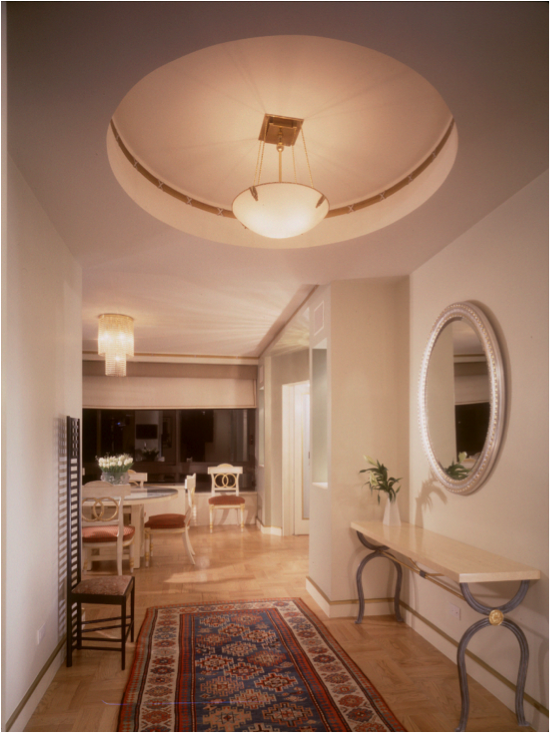
One significant function of ceilings is their ability to define specific locations within an open plan or a large room. By incorporating decorative elements or architectural changes like carving out a section of the ceiling into a distinct shape (square, round), a designer can subtly demarcate areas such as an entry foyer, an antechamber, or a dining space. This redefinition of space, even if solely on the ceiling plane, impacts the perception of the surrounding areas, creating a unique atmosphere. For example, a non-descript entry can be transformed by dropping or raising a small portion of the ceiling by a few inches, making the entrance feel more distinct. This effect can be further emphasized by adding complementary design elements like mirrors, consoles, and pendant light fixtures.
Ceilings are also instrumental in providing various lighting effects that contribute to the ambiance of a room. Cove lighting, for instance, offers a warm and elegant glow by concealing light fixtures and directing light upwards onto the ceiling plane. This creates an ethereal illumination with stronger light near the source and a softer spread towards the center of the ceiling. Colored films or bulbs can be used to introduce various hues, altering the mood of the space. Alternatively, concealed downlighting, achieved by creating slits in the ceiling to hide bulbs, directs light downwards onto walls, producing a serene and subtle warmth. Soffits can house task lighting, particularly useful in kitchens for illuminating work surfaces or for highlighting artwork on walls. Furthermore, hidden strip lights positioned above flying beams or high walls can cast upward light onto the ceiling, creating indirect and visually pleasing illumination.
To address concerns about low ceilings, design techniques can create the illusion of increased height. By strategically dropping or raising a portion of the ceiling by a small margin, perhaps six inches, designers can make an adjacent area appear significantly taller. For example, lowering the ceiling in a hallway or foyer leading to a living room with an eight-foot ceiling can make the living room ceiling seem much grander than its actual height.
Ceilings can also effectively define and guide circulation within a space. The shape of a ceiling can subtly direct movement. For instance, an oval or round ceiling in an entry can encourage a gentle flow, leading occupants along a particular path. Rotunda ceilings promote open circulation and access to multiple areas, while square or rectangular ceiling structures offer a more defined direction. Octagonal ceilings can provide a sense of privacy while still allowing for access to adjacent spaces, maintaining an open and flowing feel. The psychological impact of these shapes, even if only perceived on the ceiling, influences how individuals navigate and experience the space.
Finally, the aesthetic enhancement of ceilings through various decorative treatments adds to the overall beauty of a room. This can be achieved through molding appliqué, which introduces elegant geometric patterns and defines forms with strong emphasis, either near the ceiling or around openings. Applying different colors or decorative paint techniques to raised ceiling sections is another cost-effective way to distinguish spaces and add visual interest. More luxurious options include gold leaf, which imparts a rich and opulent feel. For those seeking intricate detail, ornamental plasterwork in various patterns and colors can significantly enlighten the surface, further dividing the space into distinct functional areas. Ultimately, the ceiling, though often disregarded, is a fundamental plane that contributes significantly to a space's functional and aesthetic excellence through both architectural and decorative interventions.
#InteriorDesign #CeilingDesign #HomeDecoration #ArchitecturalFeatures #LightingDesign #SpaceDefinition #RoomAesthetics #DesignTechniques #ResidentialDesign #InteriorDesign #CeilingDesign #HomeDecoration #ArchitecturalFeatures #LightingDesign #SpaceDefinition #RoomAesthetics #DesignTechniques #ResidentialDesign
 No comments yet
Viewrail Flight Stack


The vaulted ceiling - 2 Feb 2023 - Homebuilding & Renovating Magazine