1/4
Rewiring the seizing brain: stem cell grafts as neuromodulatory architects in epilepsy therapy
Epilepsy is a widespread neurological disorder characterized by recurrent seizures, affecting a significant portion of the global population, with approximately one-third of patients experiencing resistance to conventional antiepileptic drugs (AEDs). This highlights an urgent need for innovative treatment strategies. Stem cell transplantation has emerged as a promising therapeutic approach, showing potential to improve neurological function through various mechanisms. Transplanted stem cells can mitigate neuronal damage by replacing compromised neurons, secreting neurotrophic factors such as brain-derived neurotrophic factor (BDNF), and releasing anti-inflammatory cytokines. Preclinical studies and initial clinical trials have demonstrated that stem cell transplantation can substantially reduce seizure frequency and enhance patients' quality of life. However, these findings are based on limited sample sizes and short-term follow-ups, underscoring the necessity for further validation of long-term efficacy and safety.
Despite its potential, stem cell transplantation faces several critical challenges. Standardization of technical aspects, including the optimal cell source, processing methods, transplantation techniques, and timing, is still lacking. This variability can lead to inconsistent efficacy and safety outcomes across different stem cell types. Furthermore, potential complications such as immune rejection and tumorigenesis present significant safety concerns that need to be addressed. Future research efforts should prioritize optimizing stem cell selection and processing, designing robust clinical trials to thoroughly evaluate long-term safety and efficacy, and exploring combinatorial therapeutic approaches that integrate stem cell therapy with existing treatments. The development of advanced biomaterials could also enhance transplantation success by providing supportive microenvironments for grafted cells. Additionally, continuous monitoring of post-transplant cell survival and functionality, coupled with the identification of epilepsy-specific biomarkers, will be crucial for refining the precision and safety of stem cell-based interventions.
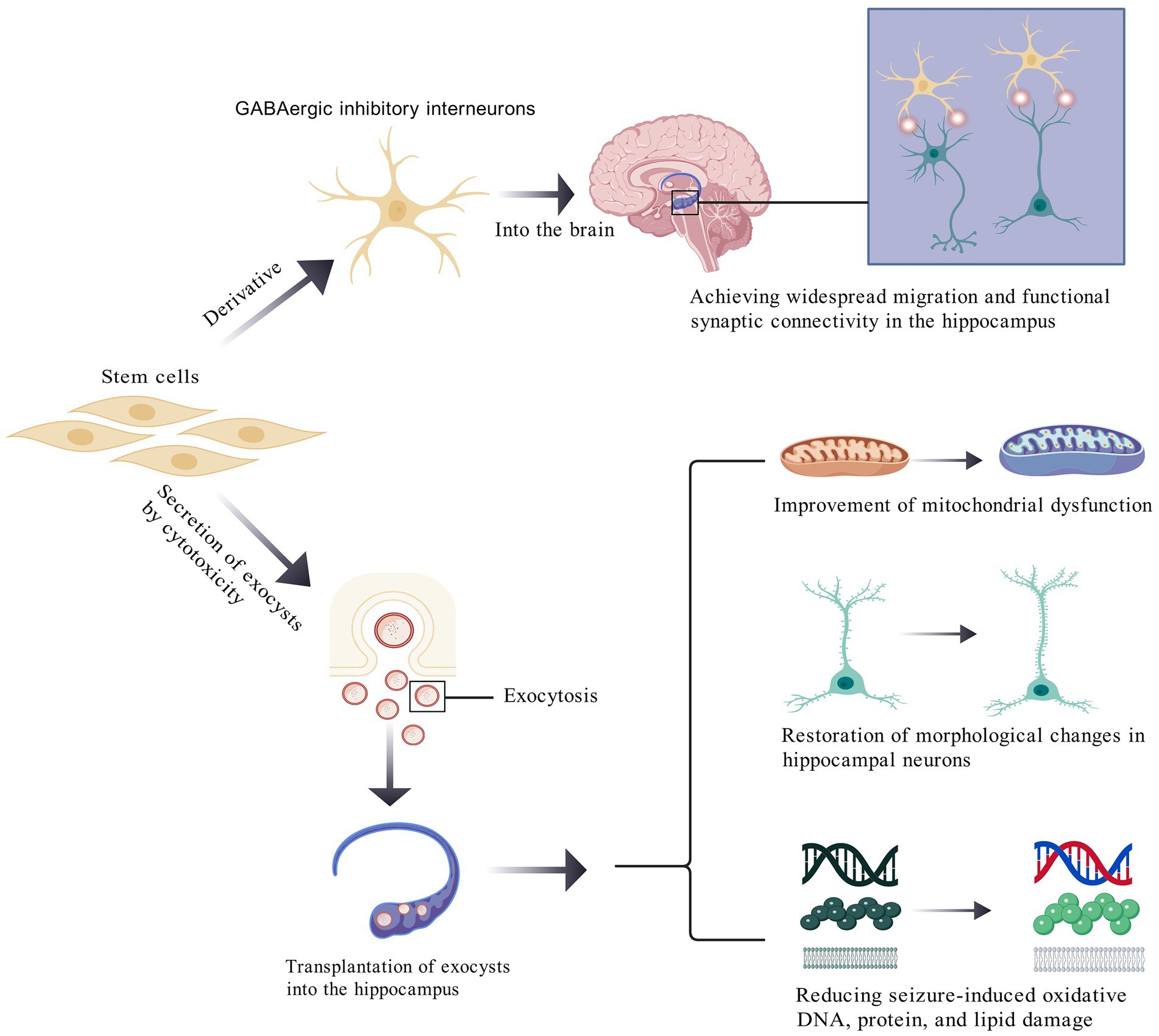
Different types of stem cells, classified by origin (embryonic, adult, induced pluripotent) and differentiation potential (totipotent, pluripotent, unipotent), offer diverse therapeutic avenues. Mesenchymal stem cells (MSCs) are particularly promising due to their regenerative, antioxidant, anti-apoptotic, and immunomodulatory properties, as well as their accessibility and low immunogenicity. Neural stem cells (NSCs) can differentiate into various central nervous system cell types, playing a crucial role in neuroplasticity and neuroimmune modulation. Hematopoietic stem cells (HSCs) are also being investigated for their immunomodulatory potential in epilepsy. The therapeutic mechanisms of stem cells include differentiation into inhibitory interneurons to restore inhibitory tone, secretion of neurotrophic factors that promote neuronal survival and plasticity, and attenuation of neuroinflammation and oxidative stress. For instance, MSCs secrete extracellular vesicles (EVs) that can mitigate mitochondrial dysfunction and restore neuronal morphology post-seizure.
Preclinical studies support the role of stem cell therapy in counteracting epileptogenic neurogenesis by suppressing ectopic migration and modulating neurogenic dynamics. Clinical trials are underway to assess the safety and efficacy of stem cell-based interventions, with some early results indicating positive outcomes in reducing seizure frequency. Advancements in technologies such as CRISPR-based gene editing and single-cell genetic reprogramming are enhancing the precision and effectiveness of stem cell therapies by allowing for targeted genetic corrections and controlled cell differentiation. The future direction of epilepsy treatment may involve personalized stem cell therapies, combining them with existing treatments like antiepileptic drugs, ketogenic diets, or neuromodulation to achieve synergistic effects and improve patient outcomes. Establishing robust ethical and legal frameworks is also vital to ensure responsible research and clinical application, balancing innovation with patient safety and societal considerations.
#StemCellTransplantation #RefractoryEpilepsy #OxidativeStress #InhibitoryInterneurons #ClinicalTranslation #Neuroinflammation #Neuroregeneration #PersonalizedMedicine #CRISPRGeneEditing #StemCellTransplantation #RefractoryEpilepsy #OxidativeStress #InhibitoryInterneurons #ClinicalTranslation #Neuroinflammation #Neuroregeneration #PersonalizedMedicine #CRISPRGeneEditing
 No comments yet
The diversity and plasticity of descending motor pathways rewired after stroke and trauma in rodents