




1/13
How to lay out and stripe a helicopter landing pad
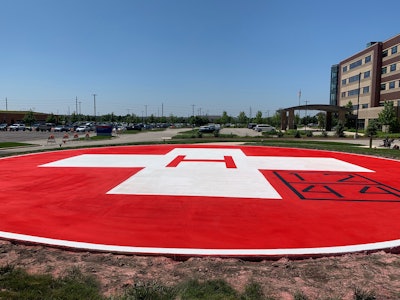
Pavement Solutions, a contractor based in Richmond, IL, was tasked with painting a helipad at Centegra Hospital in Huntley, IL, in the spring of 2018. The hospital required the helipad to be operational immediately after concrete construction, leading to a rushed painting job. John Butler, owner of Pavement Solutions, highlighted the urgency of the project, stating that they had to stripe the pad as soon as the concrete work was finished. Pavement Solutions, established in 2001, is a company with 50 employees and annual sales between $8 million and $9 million. The company primarily handles commercial work, including concrete flatwork and pavement maintenance services such as sealcoating, cracksealing, striping, and concrete joint sealing. While most of their projects are in northern Illinois, they also provide pavement maintenance services nationwide for large retail chains. Pavement marking constitutes 15% of their revenue, asphalt paving contributes 20%, concrete joint sealing another 20%, and general pavement maintenance (sealcoating, cracksealing, repair) accounts for 20%. The remaining 25% covers miscellaneous services like concrete flatwork and bollard installation.
The initial painting of the helipad presented several challenges. Pavement Solutions recognized that painting uncured concrete would likely cause issues. They informed the hospital and the concrete contractor about potential problems arising from the wax-based sealer used on the concrete. This sealer was applied to slow the curing process and prevent cracking but was incompatible with the specified chlorinated rubber paint. Despite knowing the paint would not adhere well and would need repainting within a year, the hospital urgently needed the helipad ready. Consequently, Pavement Solutions applied three coats of chlorinated rubber red paint, followed by the white medical cross, the letter 'H', and numerical markings, all while the concrete was still considered "green." The helipad was then opened for use.
A year later, in the spring of 2019, Pavement Solutions returned to repaint the helipad. The first step involved removing the old paint. They initially attempted to use a shot blaster, anticipating that some of the existing layout would remain. However, the paint was too thick for the shot blaster to be effective. They then switched to a 40,000-psi water blaster with a spin jet, which successfully removed all the paint and existing markings. This necessitated a complete re-layout of the helipad. After the pressure washing, the crew had to wait four days for the concrete to thoroughly dry before commencing the re-layout process.
The re-painting process began with applying three layers of chlorinated rubber red, ensuring each coat dried before the next was applied. Once the red base was complete, the crew, led by Eduardo Escorza Jr., who has 12 years of experience with the company, proceeded with laying out the cross, the 'H', and the numbers according to blueprints provided by the hospital. The concrete pad was 44 ft. in diameter. To find the center, two non-parallel lines were marked across the pad, bisected by perpendicular chalk lines. The intersection of these lines pinpointed the center, 22 ft. from the edge. From this central point, the 'H', which served as the landing target, was measured and laid out with an east/west orientation. Its vertical arms were 1 ft. wide and 10 ft. long, with a 2 ft. wide horizontal center, making the 'H' 6.5 ft. wide overall. The 'H' was then taped to preserve the red color. Subsequently, chalk lines were snapped to create a square within the red circle, and the white medical cross was marked within this square, extending towards the taped 'H'. A striper was used to paint the white cross, including over the taped 'H'. A 6-inch-wide white rim was also painted around the entire pad by eye. After the white cross dried, the tape was removed, revealing the red 'H'. Finally, the box for the numbers (12 for tonnage limit and 44 for maximum blade diameter) was chalked and taped off. The box outlines were painted black using a machine, while the numbers were painted by hand with a roller. The three-person crew finished the job in a single 10-hour day, with some time dedicated to waiting for paint to dry. Butler acknowledged the crew's skill, highlighting this project as another example of their intricate work, likening it to previous projects involving American flags and United States maps, and noted its value as a marketing tool for the company.
#HospitalHelipad #PavementMarking #Striping #ConcretePainting #PavementSolutions #ConstructionProject #HelipadLayout #ChlorinatedRubberPaint #PavementMaintenance #HospitalHelipad #PavementMarking #Striping #ConcretePainting #PavementSolutions #ConstructionProject #HelipadLayout #ChlorinatedRubberPaint #PavementMaintenance
 No comments yet
How to Install Deck Footings with Spread Base
From preparation to cutting, here's how to lay floor tiles