1/5
3D Gaussian Splatting: Performant 3D Scene Reconstruction at Scale
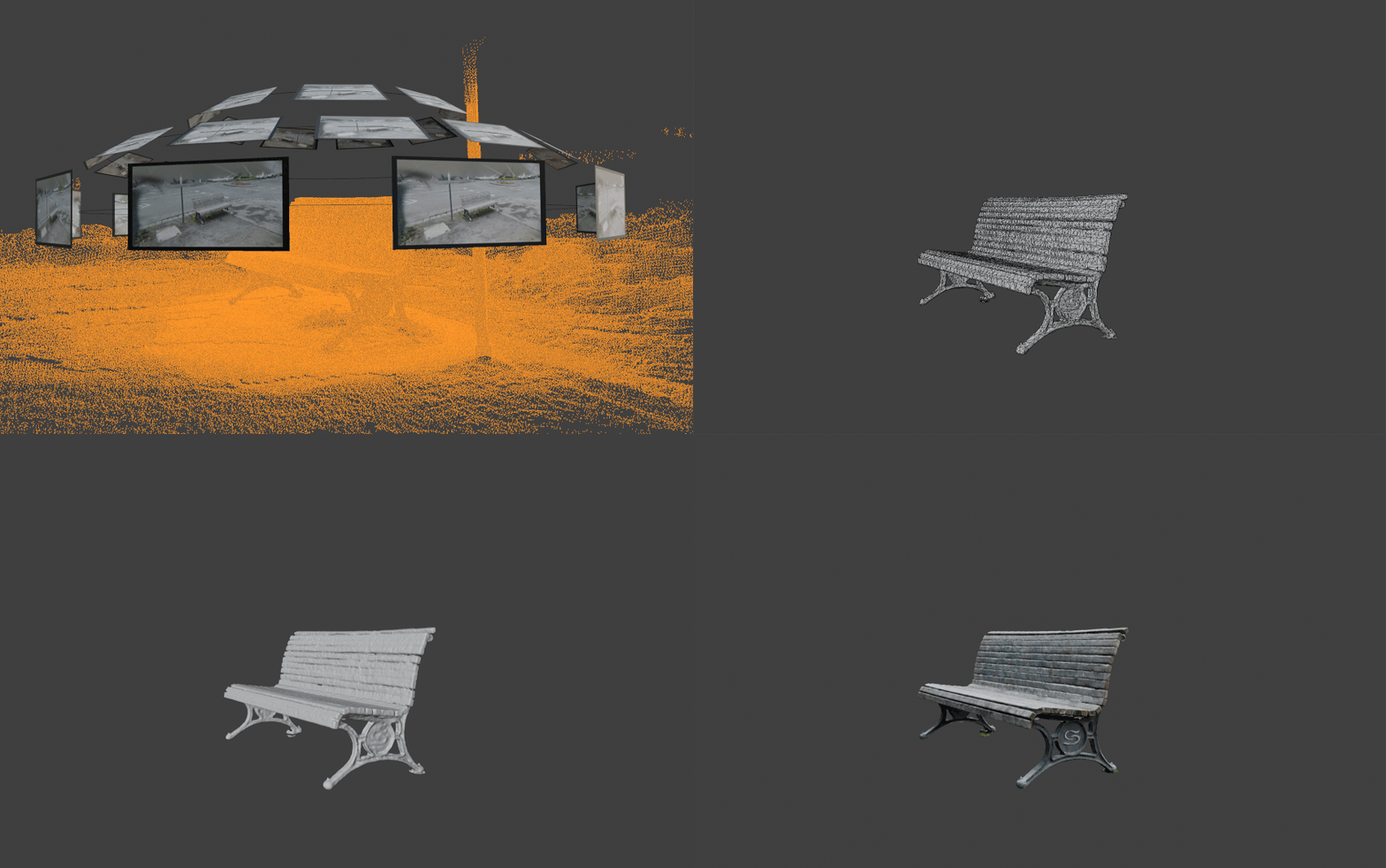
The traditional process of creating high-quality 3D content is known to be complex, time-consuming, and resource-intensive, demanding specialized skills for 3D modeling, texturing, and scene assembly. This is particularly challenging when digitally recreating real-world elements. Reality capture technologies, such as LiDAR scanning, Photogrammetry, and Neural Radiance Fields (NeRFs), offer a simplified solution by digitizing real-world objects or environments through the capture of multiple perspectives to estimate scene depth and geometry. While these automated approaches bypass manual 3D modeling and produce high-quality results faster, they typically involve expensive, specialized hardware, are compute-intensive, and often yield poor real-time rendering performance.
Recently, 3D Gaussian Splatting emerged as a new technique with the potential to accelerate 3D scene reconstruction and rasterization while maintaining high quality. Before delving into this technique, it's crucial to understand 3D reconstruction, which involves recreating a 3D scene or object from 2D inputs like photos or video. Unlike LiDAR, which provides explicit depth data, 3D reconstruction infers depth from 2D images, employing computer vision techniques like multi-view stereo and structure from motion. Photogrammetry, an older method, uses these techniques to generate a point cloud, which is then converted into a polygon-based 3D mesh. NeRFs, introduced in 2020, represent scenes as volumes using neural networks to estimate light radiance, offering faster generation but sometimes inferior detail compared to photogrammetry.
3D Gaussian Splatting, introduced in 2023, builds on NeRFs but generates novel viewpoints by populating 3D space with view-dependent “gaussians.” These fuzzy 3D primitives, with adjustable colors, densities, and positions, mimic light behavior to create volumetric representations. Unlike NeRFs, 3D Gaussian Splatting avoids neural networks, instead utilizing traditional machine learning optimization methods like stochastic gradient descent, making it more computationally efficient. This technique provides photorealistic 3D reconstruction with improved visual quality and faster generation times, reducing noise and handling challenging elements like transparency and reflectivity more robustly than previous methods.
The benefits of 3D Gaussian Splatting include shorter generation times due to direct rasterization of gaussians, superior real-time performance enabled by its volumetric, point cloud-based nature, and more robust outputs with fewer artifacts. These advantages significantly lower the barrier to entry for 3D asset creation, allowing non-specialists to create complex 3D objects using only a smartphone camera and a 3D reconstruction pipeline. It also increases accessibility to interactive, real-time 3D content on consumer devices, mobile platforms, and AR/VR, even without expensive accelerated computing. This technology could transform industries like virtual production, digital twins, and e-commerce product visualization by providing scalable, distributable, and performant interactive 3D experiences.
Deploying 3D Gaussian Splatting at scale can leverage cloud infrastructure such as AWS for asset generation, management, and global distribution. An example workflow on AWS involves ingesting 2D media, processing it through modular pipelines (image processing, structure from motion, 3D Gaussian Splatting training, and viewing), and outputting a 3D object viewable in a web browser. This workflow can be implemented using services like AWS Cloud Development Kit (CDK) for infrastructure deployment, AWS Systems Manager Parameter Store for artifact storage, Amazon S3 and CloudFront for hosting and distribution, Amazon Cognito for authentication, Amazon DynamoDB for data storage, AWS Step Functions for workflow orchestration, Amazon ECS and ECR for containerized processing, and Amazon SNS for notifications. AWS services also support elastic processing, content storage, graphics-accelerated computing (e.g., Amazon EC2 G6 instances), content delivery, analytics (e.g., Kinesis, Athena, QuickSight), AI/ML integration (e.g., SageMaker, Bedrock), and digital twin applications (e.g., AWS IoT TwinMaker). The field continues to evolve with contributions from NVIDIA (Text-to-4D with Dynamic 3D Gaussians) and Meta (Robust Gaussian Splatting), highlighting ongoing advancements in integrating AI diffusion models and improving robustness for real-world captures.
#3DGaussianSplatting #3DReconstruction #SpatialComputing #AWSCloud #RealTimeRendering #ContentCreation #MachineLearning #ARVR #DigitalTwin #3DGaussianSplatting #3DReconstruction #SpatialComputing #AWSCloud #RealTimeRendering #ContentCreation #MachineLearning #ARVR #DigitalTwin
 No comments yet
Best 3D modeling software of 2025


3DVIA


3D Wall Art Literally Adds Dimension to Your Space
3D Architectural Rendering Services at Unbeatable Price / Cost


3d rendering architecture design