1/2
Specifying cold-formed steel to meet project goals
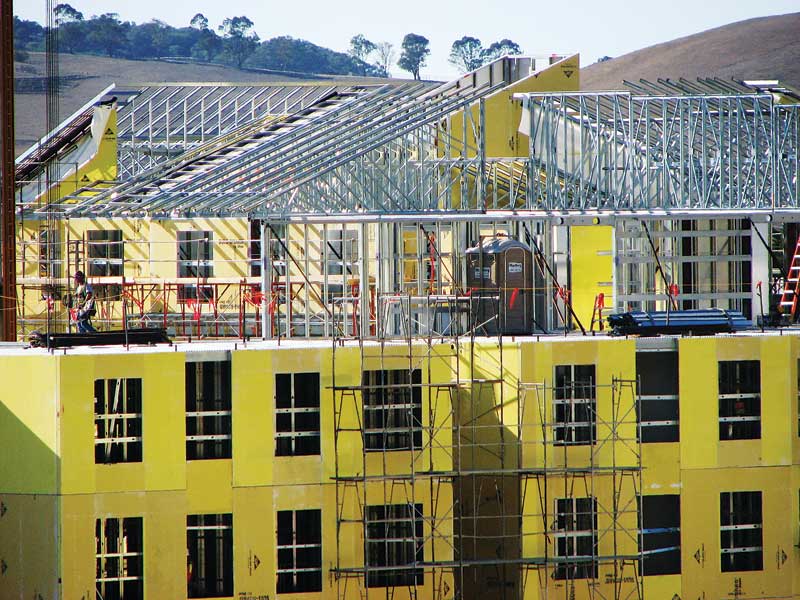
The construction industry is increasingly adopting building information modeling (BIM) for project planning and management. Cold-formed steel (CFS) panels and prefabricated components are well-suited for BIM integration due to their pre-manufacturing computer modeling. The inherent uniformity of CFS allows for accurate prediction of its attributes and interactions with other building systems. Many manufacturers provide BIM libraries with detailed CFS attributes like yield strength and load capacity. Panel and component manufacturers have also developed framing methodologies that integrate seamlessly into BIM, accounting for the needs of other trades in wall, roof, and floor spaces. The experience of CFS component detailers leads to systems with pre-designed areas, such as wall chases and large openings in floor joists, to accommodate HVAC, electrical, plumbing, and sprinkler systems, thereby reducing clash detection issues and optimizing material and system use.
When specifying CFS products, it is crucial to use current standards to avoid issues arising from outdated specifications. For example, older ASTM standards like A525 and A446 should be replaced with ASTM A1003/A1003M for steel sheet, carbon, metallic- and nonmetallic-coated for CFS framing members, and ASTM A653/A653M for steel sheet, zinc-coated (galvanized) or zinc-iron alloy-coated (galvannealed) by the hot-dip process. Guidance on proper referencing of these ASTM standards can be found in Cold-formed Steel Engineers Institute (CFSEI) Technical Notes G800-12 and G801-13.
CFS demonstrates significant durability and sustainability. In structural applications, a minimum galvanized coating of Z180 (G60) is required, and industry studies indicate such coatings can last over 100 years. For more corrosive environments or areas with moisture concerns, heavier coatings like Z175 (G90 or CP-90) are recommended. CFSEI provides technical notes on corrosion protection for fasteners and CFS framing in various climates. The North American steel industry has improved efficiency and reduced the environmental impact of steel production, allowing for more sustainable and efficient products.
CFS allows for creative building designs with less material, and its increased strength, durability, and resilience enable architects and engineers to create structures that use fewer resources and have less environmental impact, all while maintaining structural integrity. The versatility of CFS systems supports various shapes and configurations, including curved walls, ceilings, and roofs. Steel's complete recyclability ensures that CFS construction products can be sustainably managed at the end of a building's life cycle. Steel products contain 25 to 100 percent recycled content and are fully recyclable, unlike materials like wood or plastics that are often landfilled or downcycled. Specifiers should mandate a minimum recycled content of 25 percent for steel framing to meet overall building recycled content targets.
Project teams pursuing green building certifications, such as LEED v4, benefit from using CFS due to available material credits in areas like life cycle assessment (LCA), environmental product declarations (EPDs), and improved product transparency. Steel-intensive designs contribute significantly to earning these points because of the extensive data available on the supply chain, raw materials, and energy use for all steel products. Industry-wide EPDs for CFS studs, tracks, and other products are available, and individual manufacturers offer product-specific EPDs for enhanced transparency.
#ColdFormedSteel #BuildingInformationModeling #ConstructionStandards #Sustainability #Recycling #GreenBuilding #LEED #StructuralFraming #MaterialEfficiency #ColdFormedSteel #BuildingInformationModeling #ConstructionStandards #Sustainability #Recycling #GreenBuilding #LEED #StructuralFraming #MaterialEfficiency
 لا توجد تعليقات بعد
Is Quality Edge Vesta® Steel Siding Right For Your New Home?
Hot-dip Galvanized Steel