




1/21
AAU Anastas and Tomoko Sauvage create a symphony of glass and sound at Ruinart's domain in Reims
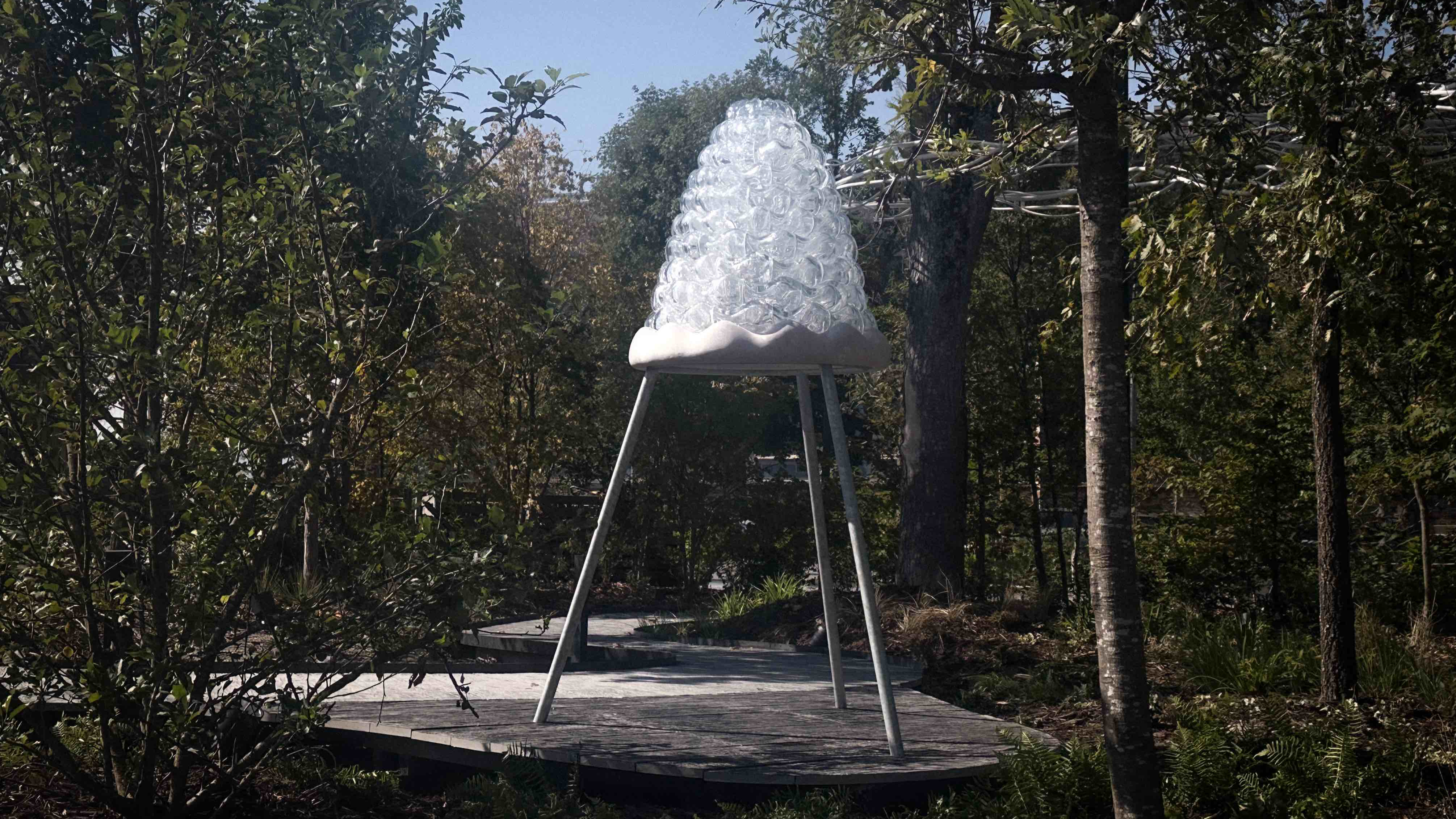
Palestinian architecture and engineering studio AAU Anastas has collaborated with Japanese sound artist Tomoko Sauvage to create a site-specific installation called _Serpentine Bell_ at Ruinart's estate in Reims, France. The conical structure, resembling a translucent hive, is constructed from 103 hand-crafted blown-glass voussoirs, which are wedge-shaped elements crucial for both its visual appeal and sonic qualities. These delicate glass surfaces refract light and enhance sound, contributing to an immersive acoustic experience. The installation stands atop a tall tripod in a clearing among trees, elevated 1.35m above the ground on steel stilts, inviting visitors to step underneath and experience it like an immersive kaleidoscope.
The project originated in 2024 when Ruinart commissioned Tomoko Sauvage for a garden installation. Sauvage then invited AAU Anastas to collaborate, based on their shared appreciation for material exploration. Elias Anastas, co-founder of AAU Anastas with his brother Yousef, noted their long-standing admiration for Sauvage's work on sound and materials. He highlighted the synergy between Sauvage's focus on the sonic qualities of materials and AAU Anastas's expertise in the precision and delicacy of stereotomic principles, particularly in shaping materials like stone. This shared sensibility became the foundation for their collaboration on _Serpentine Bell_.
_Serpentine Bell_ represents an evolution of AAU Anastas's decade-long research into traditional stone building techniques, known as Stone Matters. For this project, glass was substituted for stone, with each of the 103 blown-glass voussoirs (categorized into 11 typologies) being crafted through an experimental process using plaster molds and 3D-printed templates. These thick glass bricks interlock, providing structural integrity with minimal additional support, similar to a gift shop ceiling the studio completed in Jerusalem in 2018. The intricate and organic geometry of the structure allows it to reflect light and interact dynamically with its environment.
Upon entering the space beneath the sculpture, visitors encounter an auditory landscape created by water-filled bowls and micro air bubbles emitted by chalk stones sourced from Ruinart’s underground cellar. Light refracting through the glass distorts the surrounding trees, creating a visual effect akin to underwater reflections. Anastas explained that Sauvage’s work focuses on the subtle interplay of sound, water, and composition, while their studio emphasizes precision and finesse in working with materials. _Serpentine Bell_ merges these approaches, blending glass, and sound to create a subtle, immersive experience that fosters a deeper connection between visitors, materials, and the surrounding space.
Elias Anastas highlighted that the project explores how material can shape, reflect, and amplify sound. The flowing, bell-like forms of the structure subtly reference symbols of transformation and purification, where sound holds significant spiritual meaning in various traditions, including Japanese culture. The year 2024 was highly productive for AAU Anastas, with significant projects like 'Tiamat' at the Design Doha Biennial, exploring stone’s potential, and 'Carthagisme' in Tunis. The studio’s commitment extends to advocacy and relief efforts, channeling proceeds to initiatives like the Revive Gaza’s Farmland project and Médecins Sans Frontières. Upcoming projects across the Middle East and the UK, alongside the development of their Bethlehem-based Wonder Cabinet cultural hub into an experimental educational platform, underscore their ongoing mission.
#AAUAnastas #TomokoSauvage #Ruinart #SerpentineBell #GlassSculpture #SoundArt #ArchitectureDesign #Materiality #SiteSpecificInstallation #AAUAnastas #TomokoSauvage #Ruinart #SerpentineBell #GlassSculpture #SoundArt #ArchitectureDesign #Materiality #SiteSpecificInstallation
 ยังไม่มีความคิดเห็น