1/11
OBSESSED: Everything We Can't Stop Talking About This Week
This weekly blog post, "OBSESSED," curated by KQED Arts, features a collection of trending topics and personal fascinations from various staff members. The recurring segment covers diverse subjects ranging from nostalgic advertising and contemporary art installations to historical artifacts and pop culture phenomena, aiming to bring watercooler conversations into the digital space. Each staff member contributes a brief, enthusiastic commentary on something they've recently found captivating.
Emma Silvers, Producer for The Do List, highlights a resurfaced Sizzler commercial from 1991. She describes it as an advertising triumph due to its unusually long runtime of four and a half minutes and its peculiar tone, which she likens more to a political campaign or Cialis ad than a restaurant commercial. The commercial features smooth sax music and soft-focus shots of individuals engaged in patriotic activities, culminating in a jingle emphasizing "choices and selections." Silvers expresses admiration for the ad's unique approach and its unexpected messaging, suggesting it offers a commentary on freedom of choice.
Sarah Hotchkiss, Visual Arts Editor, introduces Leah Rosenberg’s "Chromophilia" project at Irving Street Projects. Rosenberg, an artist and pastry chef, is engaged in a three-month residency titled "Everyday, a color." Daily, she selects a color inspired by the Outer Sunset neighborhood and applies layers of this color to two walls, a section of the floor, a table, a vase, a chair, and a notebook. This process creates a continually evolving, monochromatic display where the paint gains physical depth, forming "paint icicles." Past color choices have included "ocean mist," "purple crab," and "mint graffiti." Visitors are encouraged to observe Rosenberg at work or even contribute to the painting, and to consider the psychological impact of color, specifically the “rosy hue of ‘happy hour’.”
Emmanuel Hapsis, Editor at KQED Pop, shares his fascination with a space quilt from the 1800s. Made by Ellen Harding Baker of Cedar County, Iowa, in 1876, the quilt served as a visual aid for her astronomy lectures. Now part of the Smithsonian's collection, this historical artifact reflects a long-standing human obsession with space. Hapsis also recommends a New Yorker article that draws parallels between Mars exploration and 19th-century polar expeditions.
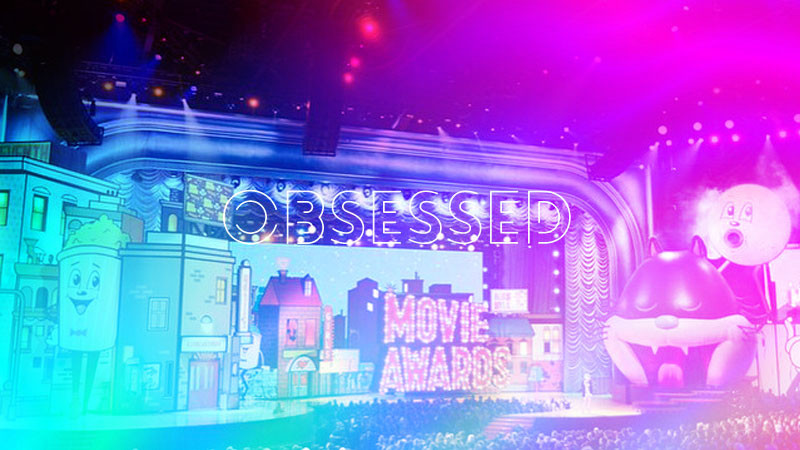
Kristin Farr, Producer for Art School, discusses the set design for the MTV Movie Awards, which featured the work of Australian artist duo Dabs Myla. The entire stage and even the golden popcorn awards were transformed by their bold and colorful artwork. Farr describes Dabs Myla as artists whose personalities are as vibrant as their art, noting their ability to create large-scale immersive installations with apparent ease. She credits their contribution with making the MTV Movie Awards feel relevant again and directs readers to additional photos and an interview with the artists on Juxtapoz.
Kevin Jones, Producer for KQED Arts, finds humor and relatability in the Instagram account "Crazy Jewish Mom." As a parent, he sees the account as a humorous and endearing portrayal of a mother-daughter relationship, particularly the mother's constant, albeit well-intentioned, harassment of her adult daughter. The account features jokes with Jewish themes, persistent efforts to find a boyfriend for her daughter (even when she's not single), and quirky advice like reminding her to do kegels. Jones views this dynamic as a loving and amusing aspect of parenting, anticipating similar interactions with his own children as they grow older.
Carly Severn, Social Media Specialist for KQED, expresses her apprehension regarding the trailer for "True Detective" Season 2. Having been a fan of the first season, she initially lowered her expectations but was still taken aback by what she perceived as the trailer's poor quality. She critiques the generic ballad playing in the background, Vince Vaughn’s strained acting, and Colin Farrell’s mustache and constant weeping. The trailer's lack of dialogue leads her to suspect that the second season might amplify the first season’s negative aspects, such as extended conversations in dark bars, detectives with marital issues, and frequent visits to strip clubs. Despite her criticisms, Severn admits she will still watch every episode, reflecting a common dedication to ongoing series.
#artsAndCulture #popCulture #visualArts #advertising #historicalArtifacts #quiltArt #spaceExploration #television #parenting #artsAndCulture #popCulture #visualArts #advertising #historicalArtifacts #quiltArt #spaceExploration #television #parenting
 Ainda não há comentários
Our Best Conversation Stories of 2020