




1/7
An ultimate guide to the power of African brutalism
The article delves into the intricate legacy of brutalist architecture across Africa, exploring its origins, diverse manifestations, and current state. The global surge of brutalism from the 1960s to the 1980s coincided with the independence movements of many African nations. This architectural style, characterized by bold experimentation, monumental scale, and the use of reinforced concrete, resonated with the optimism of state-building and the need for new infrastructure, including educational, financial, and healthcare facilities. It also provided spaces for celebrating local culture and history.
Local architects, some educated abroad, and foreign practitioners commissioned by post-colonial governments contributed to a multifaceted brutalist landscape. The style adapted to local contexts through features like brise-soleils for shade, thoughtful building orientations, and semi-open structures designed for ventilation in tropical climates. Some designs incorporated forms and decorative elements inspired by cultural references. However, brutalism also presented contradictions. In apartheid South Africa, it was used as a tool of control, and in former Portuguese colonies, its legacy is intertwined with colonial rule. The rapid construction often led to colossal structures that were resource-intensive but sometimes failed in their intended functions. International architects frequently received commissions, while local African architects, many of whom shaped the unique characteristics of African brutalism, often remained unrecognized.
Today, many of these brutalist buildings face neglect. Their high maintenance costs and the perceived lower cost of demolition over restoration pose a significant threat. Nevertheless, these structures serve as important markers of a historical period, warranting study and preservation. There is a growing interest in their critical re-evaluation, aiming to transform them into contemporary assets. Their potential for adaptive reuse and the lessons they offer in contextual design are highlighted as reasons for documentation and conservation.
The article provides several examples of brutalist typologies across the continent. The West African Development Bank (BOAD) in Lomé, Togo, designed by DMT Architectes and Raphaël Ekué Hagbonon, exemplifies how local cultural references, like the Tatas Tamberma compounds, were integrated into modernist design. The BOAD building is noted for its commitment to preservation, with a dedicated conservation office and an architectural archive. Obafemi Awolowo University in Ife-Ife, Nigeria, designed by Arieh Sharon with Eldar Sharon and Augustine Akhuemokhan Egbor, showcases climate-responsive buildings. Established post-independence, these university campuses were vital for intellectual discourse and are now recognized as part of the Bauhaus international heritage, with ongoing conservation efforts.
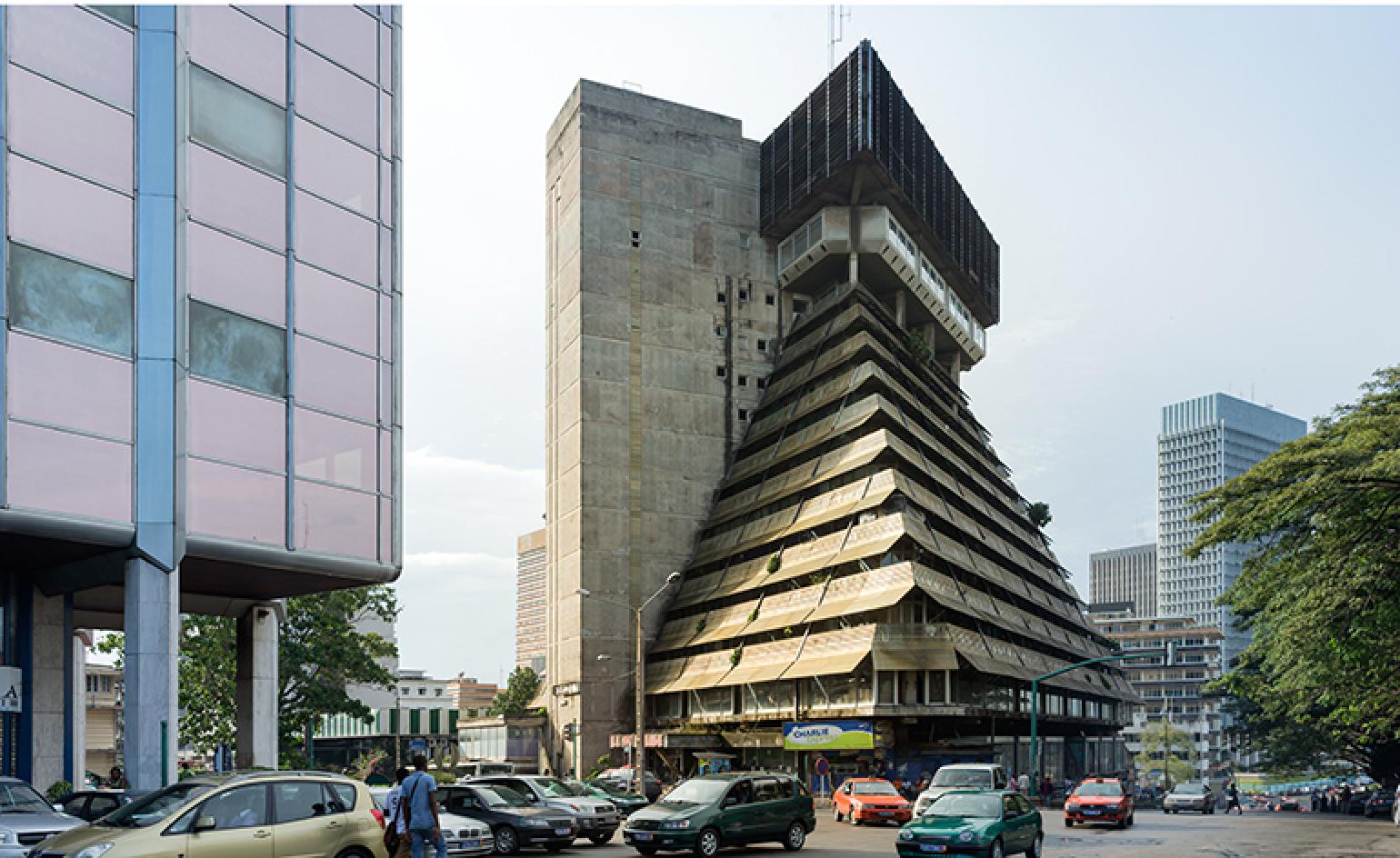
La Pyramide in Abidjan, Ivory Coast, an abandoned multi-use complex by Rinaldo Olivieri, stands as a symbol of unfulfilled ambitions. Its pyramid shape and concrete tower, while iconic, proved ill-suited for its function, leading to its current derelict state despite past renovation plans. The Hôtel du Lac in Tunis, Tunisia, by Raffaele Contigiani, is an inverted pyramid luxury hotel reflecting the era's optimism for tourism. Abandoned since 2000, it remains a recognized brutalist landmark. The Cinema Studio Namibe in Moçâmedes, Angola, by José Botelho Pereira, an unfinished concrete saucer, illustrates how political upheaval, specifically Angolan independence, interrupted architectural visions tied to colonial propaganda. The Place des Cinéastes (Filmmakers’ Square) in Ouagadougou, Burkina Faso, by Ali Fao and Ignace Sawadogo, is a distinctive monument celebrating pan-African filmmakers. The Kenyatta International Conference Centre (KICC) in Nairobi, Kenya, by Karl Henrik Nøstvik and David Mutiso, a cylindrical tower with a conical amphitheater, continues to be a central venue for political and cultural life, scheduled to host Africa’s first architectural biennale. Finally, the National Museum of Ethiopia in Addis Ababa, designed by Gashaw Beza Tesfamichel, showcases brutalist vocabulary softened by a vibrant mural, reflecting the nation's socialist orientation and political trajectory.
#AfricanBrutalism #BrutalistArchitecture #PostColonialArchitecture #ArchitecturalPreservation #ModernistArchitecture #AfricanDesign #ArchitecturalHistory #CulturalHeritage #AfricanBrutalism #BrutalistArchitecture #PostColonialArchitecture #ArchitecturalPreservation #ModernistArchitecture #AfricanDesign #ArchitecturalHistory #CulturalHeritage
 Nog geen opmerkingen