



Why Is the Floor of the Oculus Already Crumbling?
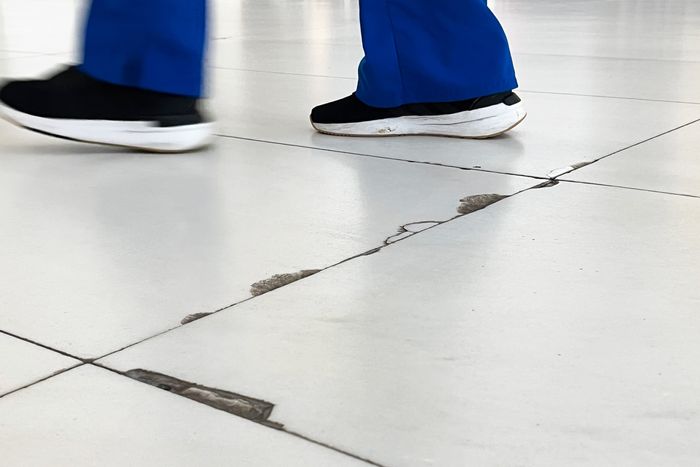
The article explores the premature deterioration of the floor at the World Trade Center Oculus, a structure that opened in March 2016 and was designed by Santiago Calatrava. Despite its majestic Italian-marble walls and glowing white ribs, which evoke the grandeur of a cathedral and offer commuters a moment of uplift, the floor presents a stark contrast. The white stone slabs are chipped and flaked, with broken corners and dirt ground into the rough spots, making the damage highly visible. Some replaced slabs stand out due to their newness compared to the worn original flooring.
The author notes that Grand Central Terminal, a structure 110 years older, has a Tennessee marble floor that, despite billions of footfalls, shows only gentle wear rather than extensive cracks and chips, suggesting it is in better condition than the Oculus floor. The Port Authority of New York and New Jersey, responsible for the Oculus, acknowledged the wear and tear as part of ongoing facility maintenance, stating that repairing and replacing damaged tiles is systematic. They mentioned a temporary halt in replacement work for the holidays, with plans to resume later in the year, but provided no detailed explanation for the problem. Calatrava’s office declined to comment on the matter.
The material used for the floor is Lasa marble, sourced from Italy and imported through Vermont. This marble is known for its pure, uniform white color and slight translucence, and it has been used in European monuments and military grave markers. On the Mohs scale, Lasa marble is relatively soft (3-4), especially when compared to granite (6-7). An architect involved early in the project, Raffie Samach, expressed surprise at the choice of Lasa marble for a public space, citing its fragility, although he conceded its beauty and noted that the Port Authority had vetted material choices for durability.
A comparative test conducted by the author revealed that the Lasa marble from the Oculus was significantly more fragile than the Grand Central Terminal’s marble, shedding crystalline crumbs when rubbed. However, the smooth top surface of a Lasa marble sample did not chip easily, raising questions about its in-situ performance.
The highly polished, geometrically pure design of Calatrava’s structures means that even minor imperfections appear as damage rather than a natural patina, unlike the more ornate Beaux-Arts buildings where weathering can add to the aesthetic. However, the primary cause of the floor’s deterioration is linked to a radiant-heating system beneath the floor. This system, which circulates warm glycol solution through thin pipes, causes the stone slabs to expand. Due to the limited number and narrowness of expansion joints, the expanding stone presses against itself, leading to shattering.
According to Matthew Crawford, a superintendent involved in the floor’s installation and maintenance, the project team rejected recommendations for wider, one-eighth-inch expansion joints with caulking, opting instead for fewer, widely spaced joints to maintain aesthetic alignment with wall joints. Implementing wider joints or a thicker mortar setting bed (which would have limited stone movement and improved durability) was deemed too costly or detrimental to the building's LEED goals (by reducing R-value, or thermal resistance). Crawford also mentioned glycol leaks in the heating system, contributing to brown stains.
Evidence supporting this theory comes from the Oculus’s upper levels, which use the same Lasa marble but lack the radiant heating system and are in much better condition. Furthermore, a section of the floor without heating pipes, re-laid by Crawford’s company with a thick mortar bed, remains largely undamaged despite heavy traffic. The Port Authority has seemingly begun to adopt some of these recommendations, with newer replacement stones appearing to be caulked rather than grouted. Repairing the entire floor, including re-honing, is an expensive and ongoing process that will likely result in a patchy appearance until fully completed.
The author concludes that during the planning of the Oculus after 9/11, there was a strong desire for an aesthetically perfect and monumental structure, leading to a de-emphasis on practical concerns and long-term durability. This prioritization of beauty over practicality is evident in the current state of the floor, forcing visitors to 'look up' to appreciate the architecture and 'avert their eyes' from the damaged floor.
#Oculus #WorldTradeCenter #SantiagoCalatrava #ArchitecturalDesign #UrbanPlanning #BuildingMaintenance #LasaMarble #RadiantHeating #ConstructionFlaws #Oculus #WorldTradeCenter #SantiagoCalatrava #ArchitecturalDesign #UrbanPlanning #BuildingMaintenance #LasaMarble #RadiantHeating #ConstructionFlaws
 Noch keine Kommentare
New-old flooring: cement tiling on its way back| Gulf Times

Get Floored