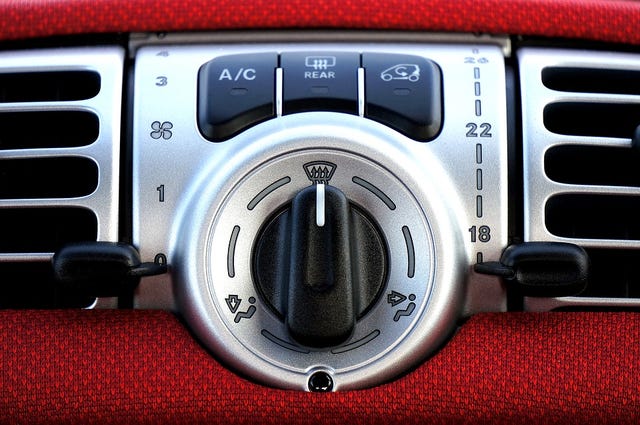
1/3
Everything You Should Know About Fixing Your Car's A/C
Maintaining a car's air conditioning (A/C) system can be complex and costly, with many misconceptions surrounding repairs and refrigerants. Over time, an A/C system's effectiveness diminishes, leading to warm air output. Recharging the A/C can cost hundreds of dollars, and DIY solutions are often viewed with skepticism due to past issues with ingredients. For older cars, pre-1994 models, converting from the older R12 Freon to the current R134a standard involves significant labor and expense, primarily due to the need to replace numerous small rubber seals.
Automotive A/C systems are not perfectly airtight; refrigerant slowly leaks out as a colorless gas. According to Ward Atkinson, an air conditioning expert with the Society of Automotive Engineers (SAE), R134a systems leak less than older R12 systems. For instance, a 2017 car leaks an average of 0.41 ounces of refrigerant annually, a substantial improvement from the 2.36 ounces per year estimated for cars in 2001 by the European Union. Continuing to operate an A/C system that blows warm air can cause further damage. Refrigerant is mixed with lubricating oil essential for the A/C compressor's smooth operation. Running the system dry can lead to compressor burnout due to a lack of lubrication. Many refrigerants include an ultraviolet-sensitive dye, which, while the refrigerant evaporates, leaves a traceable stain from the oil/dye mixture, allowing technicians to locate leaks using an ultraviolet light.
Converting an R12 system to use R134a typically results in noticeably less effective cooling. This is because R12 systems were specifically designed for R12. When converting to R134a, about 25 percent less refrigerant must be used to accommodate R134a's higher operating pressure. While R134a is more efficient pound for pound, the reduced quantity means a decrease in overall cooling power. Shops often reuse refrigerant, running it through a recovery machine to remove contaminants. This recycled refrigerant functions identically to new refrigerant, as it does not degrade over time like brake fluid or coolant. Consumers might pay for 'new' R134a, but a portion could be cleaned, recycled refrigerant without any adverse effects on performance.
Manufacturing of R12 Freon was banned in most countries, including the U.S., between 1996 and 2010. While still available, federal Clean Air Act regulations require certified technicians for its purchase and handling. Amateur attempts to recharge R12 systems risk releasing harmful refrigerants into the atmosphere. DIY refill cans claiming to be R12a or R134a replacements may contain flammable hydrocarbons like butane and propane, which are illegal for use in A/C systems due to fire hazards. Products like Hot Shot and Freeze 12 have their own formulas, but experts like Atkinson and Candido Figueroa of Auto A/C World generally advise against DIY cans, particularly those with stop-leak additives. These additives, often metallic filings or pellets, can react with moisture throughout the system, leading to clogs rather than just sealing leaks. Mixing refrigerants like R12 and R134a is problematic because they operate at different pressures, and their respective lubricants (mineral oil for R12 and synthetic polyalkylene glycol or PAG oil for R134a) are incompatible. Proper conversion requires completely draining the old R12 and its mineral oil before refilling with R134a and PAG oil. In some cases, converting an older R12 system to R134a might require replacing the condenser, as older condensers might lack the capacity for R134a's higher pressures. All seals in the compressor must also be replaced to prevent PAG oil from degrading seals designed for mineral oil.
Using computer keyboard duster (R152a) as a cheap alternative for A/C systems is highly dangerous due to its extreme flammability, posing a significant fire risk, especially when blown through dashboard vents. While OEMs are experimenting with R152a as an R134a replacement for future designs, it is unsuitable for existing R12 or R134a systems. Incorrect A/C repairs and the use of inappropriate refrigerants can lead to severe safety hazards, including fires, making professional service and adherence to proper procedures crucial for effective and safe vehicle air conditioning.
#CarAC #ACRepair #AutomotiveMaintenance #Refrigerant #R12 #R134a #DIYCarRepair #VehicleSafety #EnvironmentalRegulations #CarAC #ACRepair #AutomotiveMaintenance #Refrigerant #R12 #R134a #DIYCarRepair #VehicleSafety #EnvironmentalRegulations
 Noch keine Kommentare
HVAC Maintenance Guide: What to DIY and When to Call a Pro


How to get the most life out of your AC and Heating system
Practical Advice for Installing an Air Conditioner

Ask Angi: What should I do when the AC goes out?
5 Best AC Repair Miami Locals Trust